Buying Guides
Disposable Gloves Over or Under Chainmail Gloves?
A disposable glove goes over chainmail when it must cover the food-contact surface, and inside when it must keep the hand clean and dry. The order follows the job of the layer.
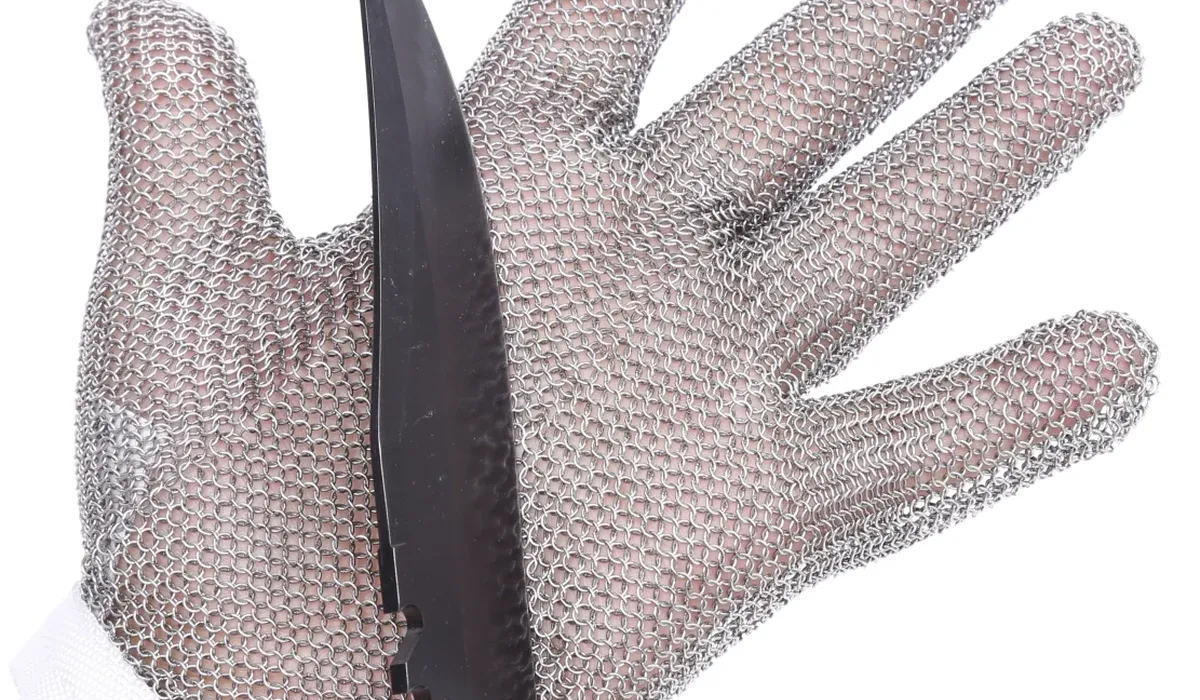
Use a suitable disposable glove over the chainmail when you need to cover the mesh's food-contact surface. An inner disposable glove may instead be chosen to help keep the hand clean and dry.
The order follows the job of the layer and the site's hygiene procedure, not habit: the outside layer answers the food, and the inside layer answers the hand.
This guide shows you when each order fits, how to check the complete combination, and what a disposable cover does not do. It covers food work where chainmail and disposable gloves are worn together.
It does not set your site's hygiene procedure — your local rules and your site's procedure decide what applies. Choose the order by the job, and the combination works.
Outside: Cover the Food-Contact Surface
Consider slicing cooked meat for serving, with no further cooking step. The food will be eaten as it is, so the surface that touches it has to meet the rule for ready-to-eat food.
If the procedure calls for covering bare chainmail, the disposable cover belongs outside. A glove underneath the mesh would leave the food touching the chainmail itself, and that answers nothing.
The food code model behind this is the FDA's 2026 Food Code, which distinguishes food that will be cooked afterwards from ready-to-eat food that will not. For the latter, slash-resistant gloves need a smooth, durable, nonabsorbent outer surface, or a covering glove with those properties, or a single-use covering glove.
This is a model for US retail and food service. Locally adopted rules and the site's procedure determine the applicable requirements, so read the code as a model, not as your site's rule.
The outer cover changes what the food meets. With the disposable glove outside, the food meets a smooth cover, not the mesh. The chainmail still does the protective work underneath, and the cover does the food-contact work on top.
Neither layer replaces the other. The cover is single-use, so it is changed when it is damaged or contaminated, the same way any disposable glove is changed.
Choose the cover for the food, not for the hand. A cover that tears during the task stops covering, and a cover that is too thick for the work stops the wearer from handling the food properly.
Try the actual cover with the actual chainmail glove before the task, and check that the combination still lets the wearer grip, turn and release the product.
The outside order also decides the cleaning. A disposable cover does not clean the chainmail, and the chainmail still needs its daily wash in 50 °C soapy water, drying and cool, ventilated storage. The cover is changed. The mesh is washed. Do not confuse the two.
Inside: A Barrier for the Hand
An inner disposable glove has a different purpose. Food-processing reference material describes polymer gloves worn under or over food-safety gloves to help keep hands clean and dry. It treats these barrier gloves separately from knitted liners used for warmth, comfort or fit, and the distinction matters: a barrier and a liner are different purchases for different jobs.
Consider a station trimming raw meat that will be cooked later. The site might select a suitable inner barrier for wet work while leaving the chainmail as the outer surface. That choice does not clean or cover the mesh.
The chainmail's food-contact use still has to fit the procedure for that process, because the food still meets the mesh. The inner glove answers the hand. It does not answer the food.
For sweat absorption, workplace guidance mentions cotton liners — a separate choice from a disposable barrier. An inner nitrile glove, a cotton liner and an outer food-contact cover are therefore not interchangeable purchases.
One keeps the hand dry, one absorbs sweat, and one covers the food-contact surface. Buying one when you need another leaves the job half answered, so name the job before you name the layer.
The inner barrier also changes the fit. A disposable glove inside the chainmail takes up space, and the chainmail has to close over it without pinching or pulling at the fingertips.
That is a fitting question, not a sizing rule, and it is answered by trying the combination, not by ordering a larger chainmail glove. A change of liner or cover is a reason to check the combination again. It is not an automatic instruction to order the chainmail one size larger.
Fit the Complete Combination
For a sample fitting, use the actual inner and outer gloves planned for the task. Check finger movement, grip and the wrist closure, including whether either layer pulls at the fingertips or forms awkward folds.
The check is done with the real layers, on the real hand, doing the real movements. A fitting done with one layer missing proves nothing about the combination.
Watch the wrist first. The chainmail closure — a steel hook on the 5201, an adjustable textile strap on the 5101, a plastic snap strap on the 5301 — has to close over whatever sits underneath it.
A strap that cannot close firmly over an inner glove will loosen during the shift, and a hook that catches on a disposable layer will tear it. The closure and the layers are one system, so check them together.
Watch the fingertips second. A disposable layer that bunches at the fingertips takes away the feel the task needs, and a chainmail glove that is too tight over an inner glove will pull at every movement. Either problem shows up in the first minutes of a fitting, and both are cheaper to find before the order than after it.
Watch the grip third. Wet work, fat and food residue change how the hand holds the product, and a disposable cover changes it again. If the combination slips where the bare chainmail did not, the cover is wrong for the task, not the chainmail. Change the cover and check again, before you change the protective glove.
What a Cover Does Not Do
Food-contact suitability, fit and mechanical protection are separate checks. A disposable cover does not replace the protective glove, and the protective glove does not replace the cover. Each answers its own question, and passing one check says nothing about the others.
A disposable cover does not change what the chainmail protects against.
The rings are AISI 316L stainless steel, 3.81 mm across, linked with 0.52 mm wire, and the glove is certified model by model under EN 1082-1: the 5201, the 1201 series, the 5301 and the 1301 series under certificate 2777/26322-01 to 2029-10-24, and the 5101 under certificate 2777/12679-02 to 2029-04-26.
The cover sits on top of that protection. It does not add to it, and it does not take away from it.
A disposable cover does not prove food-contact suitability on its own either. Our 316L stainless steel passed SGS food-contact testing, FDA and LFGB, in 2024, at material level.
That is a test result, not an approval from the FDA, and we will not call it anything more. The cover's own food-contact suitability is a separate question for its own supplier, and the site's procedure decides what counts.
Do not test cut resistance by cutting against a glove while someone is wearing it. That rule holds with or without a disposable layer on top, and no fitting session is an exception. The fitting checks movement, grip and closure. It never checks protection.
The site's hygiene routine still includes handwashing, changing disposable gloves when damaged or contaminated, and cleaning the chainmail. A cover that is changed on schedule and a mesh that is washed daily are both part of the routine. One does not excuse the other.
Your Next Step: Make the Sample Request Specific
When asking about five-finger chainmail gloves, explain the cutting task, whether the food will receive further cooking, and whether you need an inner glove, an outer cover or both. Include the intended gloves' details so the chainmail model and the sample requirements can be discussed together.
Those lines decide the model, the layers and the fitting, and they are enough for us to confirm the match without a second round of questions. Send them to sales@steeloramesh.com, and we will confirm which model fits, list any evidence still missing, and reply within 1 working day.
Enquiry checklist
The cutting task, and whether the food is cooked afterwards.
Inner glove, outer cover, or both — and the job of each layer.
The intended disposable gloves' type and size.
Chainmail model, size and closure type.
Whether the site's procedure calls for covering the mesh.